

Frank Tuerling
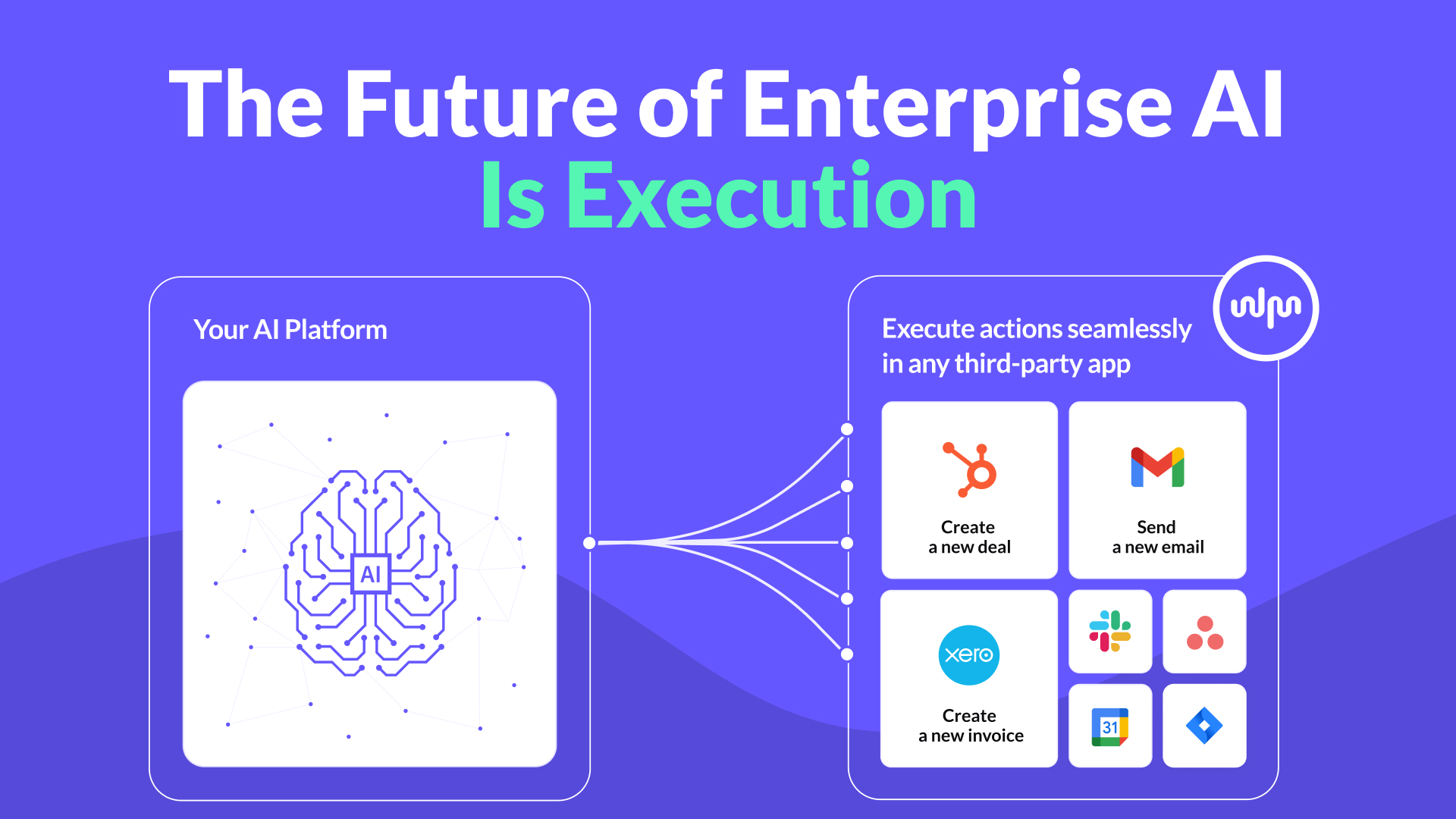
AI Changed Work. Execution Is Next.
Artificial intelligence has changed the way we work in only a few months. The pace is unprecedented. And it is accelerating.
Why?
Because AI platforms deliver immediate, tangible value. They enable companies to process information, generate output, and increase efficiency at a scale never before possible. From ideation to execution, from development to controlling, from sales to operations, AI is rapidly becoming a core productivity layer across departments.
This dynamic has fueled explosive adoption and the rise of enterprise AI platforms built on large language models. These platforms do not just assist with isolated tasks. They elevate entire workflows.
But one topic is still at the beginning.
Work in companies does not happen in isolation. Processes move across teams, departments, and tools. If AI platforms are meant to elevate real business processes, they must operate across that entire landscape.
Cross-app workflow orchestration is the next frontier.
And it requires more than intelligence.
Execution Is Harder Than Insight
At first glance, execution seems straightforward. If an AI platform understands intent and generates a structured action plan, how hard can it be to call an API?
In reality, this is where complexity begins.
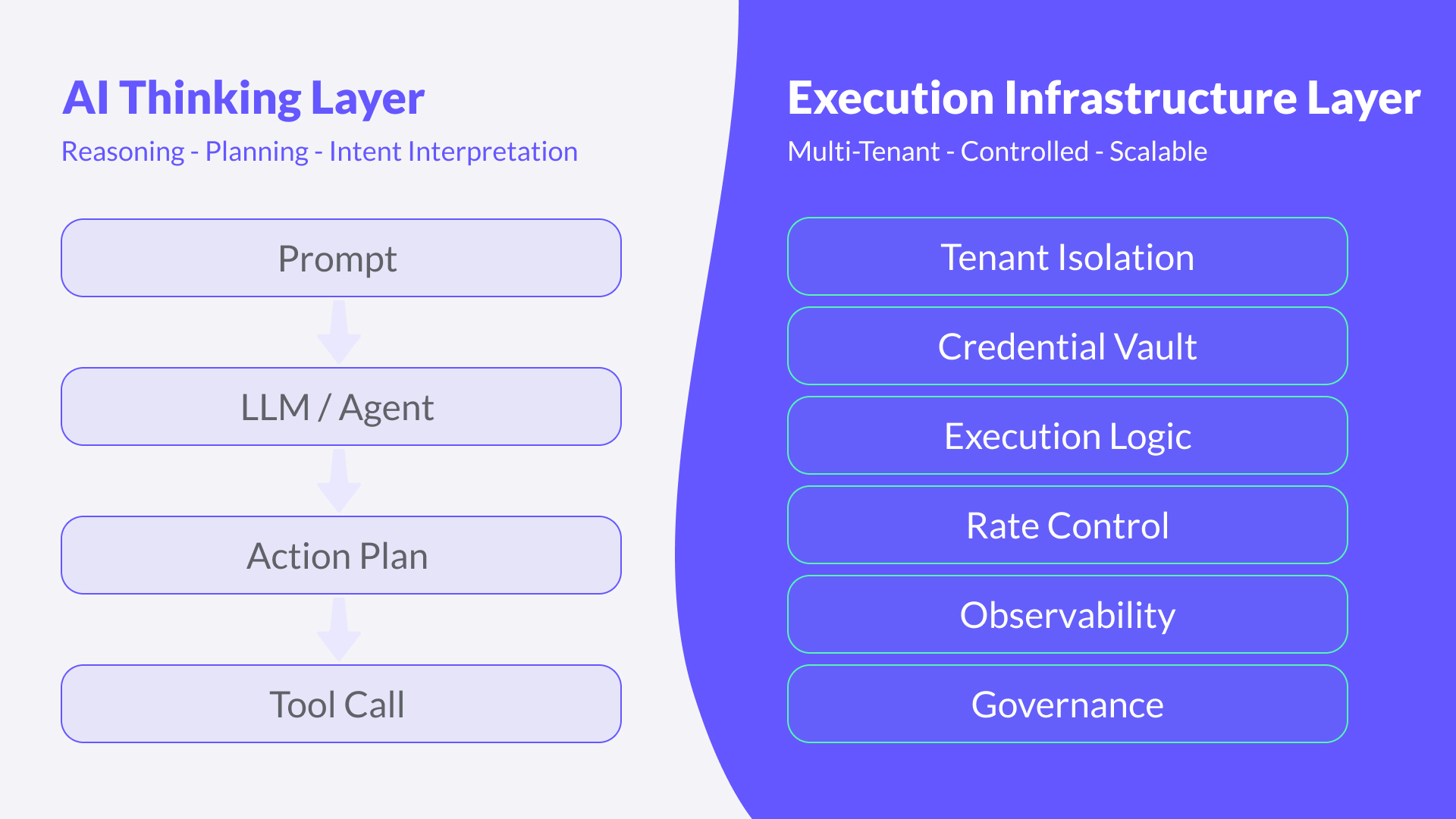
Modern AI platforms are remarkably good at reasoning. But thinking is not the same as acting.
This is where many teams turn to standards like MCP. The Model Context Protocol is an important step forward. It allows an AI platform to connect to external tools in a structured way and access APIs in real time.
But MCP enables connection. It does not provide governed, repeatable, multi-tenant execution infrastructure. Enterprise workflows require persistent credential management, tenant isolation, rate control, retry handling, observability, and controlled execution across environments.
We explored MCP’s role and limitations in more depth in our dedicated article on MCP for workflow automation: Using MCP for Workflow Automation: What Works, What Doesn’t, and What You Actually Need
Execution becomes even more complex when real customer workflows enter the picture.
- Updating a CRM record is not just sending JSON.
- Creating an invoice is not just triggering an endpoint.
- Posting to Slack is not just a webhook call.
Each action runs inside a customer-specific environment with its own pipelines, stages, field mappings, and approval logic. No engineer can anticipate every configuration across countless tenants.
And this is not a one-time interaction. Enterprise AI platforms execute continuously, across a vast number of customer environments.
Now the problem shifts from intelligence to infrastructure.
When AI Teams Become Infrastructure Teams
When execution becomes part of the product, the organization begins to change.
At first, the effort feels incremental. A new integration. Additional permission handling. Some retry logic. More configuration options in the UI.
Over time, these additions accumulate. Teams build credential vaults, isolation layers, reusable execution logic, observability pipelines, rate handling, and workflow configuration UX. Reliability expectations increase.
Engineering time shifts from improving intelligence to stabilizing execution. The AI team slowly becomes an infrastructure team, often without explicitly deciding to do so.
This shift happens quietly, integration by integration, until execution infrastructure dominates the roadmap.
Enterprise AI Requires an Execution Layer
Enterprise AI execution is not a feature. It is a platform layer.
It requires a universal capability to execute across public APIs, tenant-isolated runtime contexts, persistent credential management, and strict governance over how actions are triggered and controlled.
Execution must operate safely across hundreds or thousands of customer environments. Each environment has its own users, permissions, execution logic, and data boundaries. Actions must run in the correct tenant context without ever exposing data across customers.
Enterprise-grade execution also requires rate control, retry logic, concurrency handling, observability, and auditability. It requires reusable execution logic that can be defined once and deployed safely across tenants while remaining configurable within controlled limits.
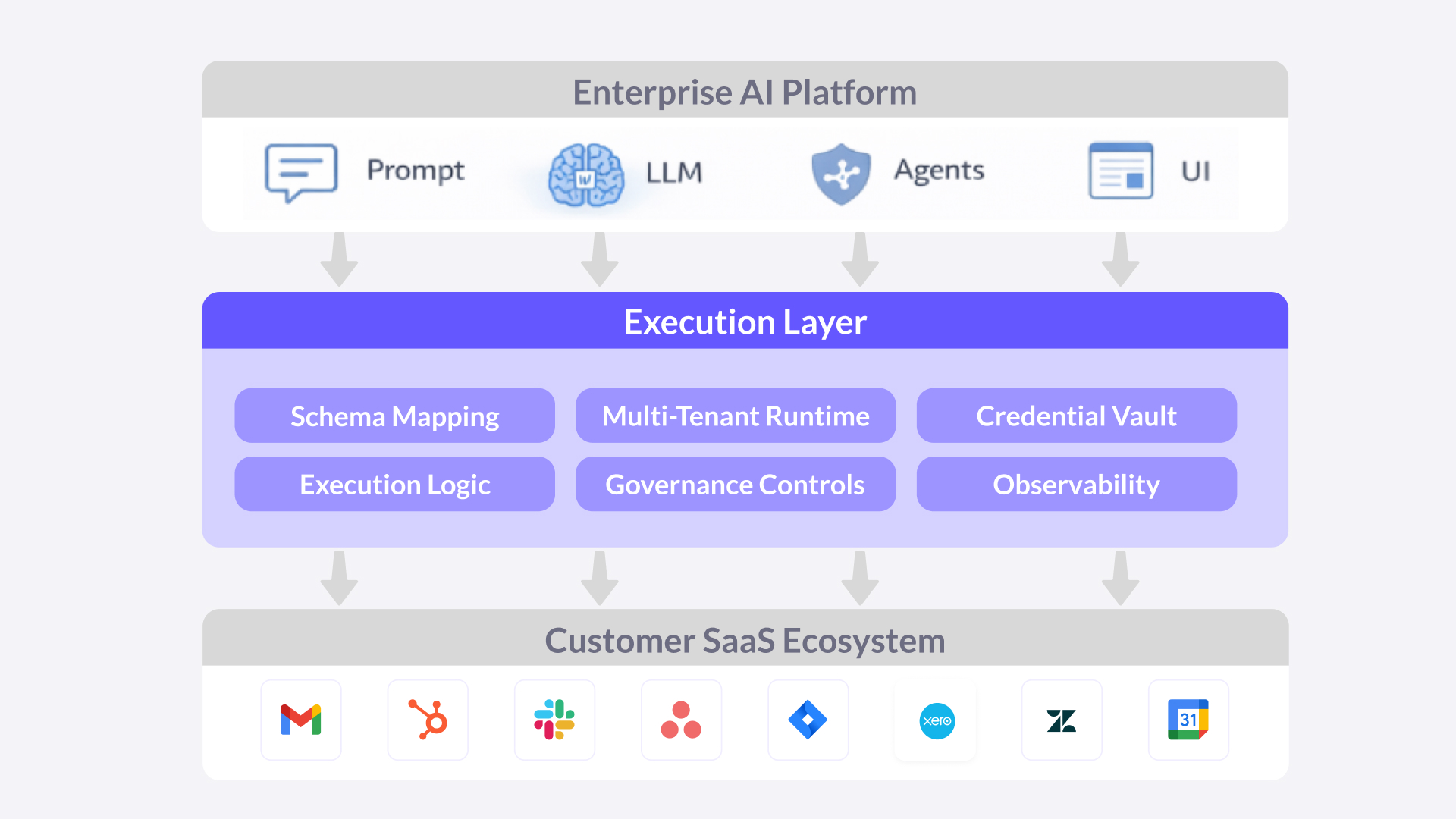
Without this foundation, execution remains fragile. With it, AI platforms can operate reliably across real business processes.
Why Zapier and n8n Cannot Power Enterprise AI
At this point, some teams consider embedding an existing automation platform such as Zapier or n8n behind the AI layer.
These platforms are powerful for individual users. But they were not designed as governed, multi-tenant execution backbones for enterprise AI platforms.
They assume user-owned workflows, external dashboards, and decentralized control. Enterprise AI platforms require strict tenant isolation, centralized governance, embedded authentication flows, and full execution control inside the product.
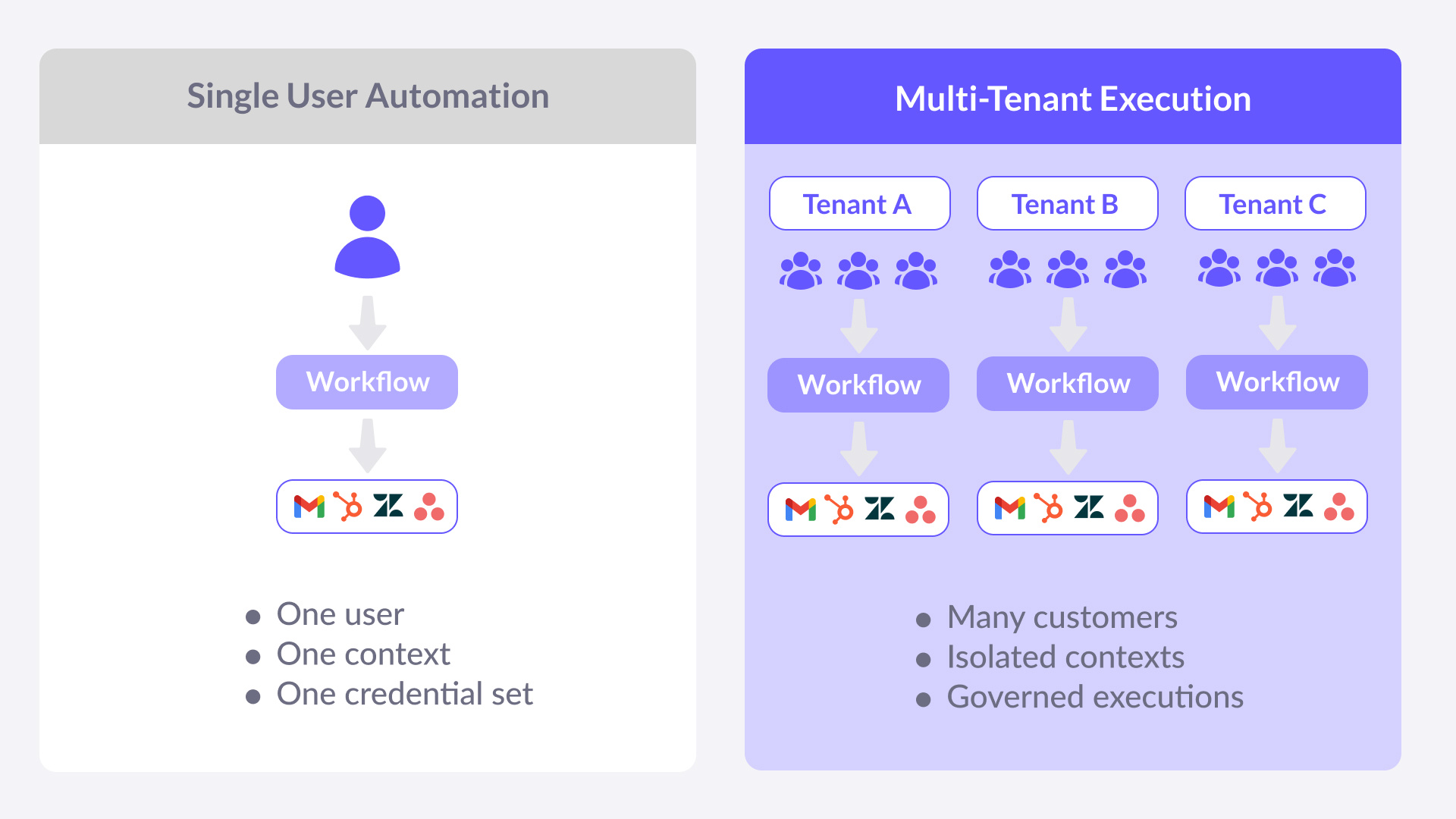
Trying to embed external automation tools into a multi-tenant AI architecture quickly introduces structural limitations.
n8n is a good example. While powerful as a standalone automation tool, it is not designed as a multi-tenant execution backbone for SaaS platforms. Running n8n in an embedded scenario requires heavy customization to simulate tenant isolation and governed lifecycle control. We explored this in detail in our article on embedding n8n in a SaaS app: Embedding n8n in Your SaaS App: What’s Possible and What You’ll Need to Build
What works for end-user automation does not automatically translate into platform-level execution infrastructure.
The Missing Layer: An Automation Engine
Enterprise AI platforms do not simply need more prebuilt integrations or API connectors. They need an automation engine.
An automation engine provides a universal API layer, multi-tenant execution runtime, credential vault, governance controls, observability, and reusable execution logic. It acts as the execution backbone that transforms AI intent into reliable, cross-app action.
Without an execution engine, AI remains intelligent but operationally fragile. With one, it becomes enterprise-ready.
One Universal API for Enterprise AI Execution
FlowMate is built as an automation engine for enterprise AI and SaaS platforms that require secure, scalable cross-app execution.
Instead of building and maintaining execution infrastructure in-house, AI platforms integrate a universal execution layer via one universal API. FlowMate handles authentication, tenant isolation, rate control, retry logic, observability, and universal endpoint coverage, while your product retains full control over user experience and agent behavior.
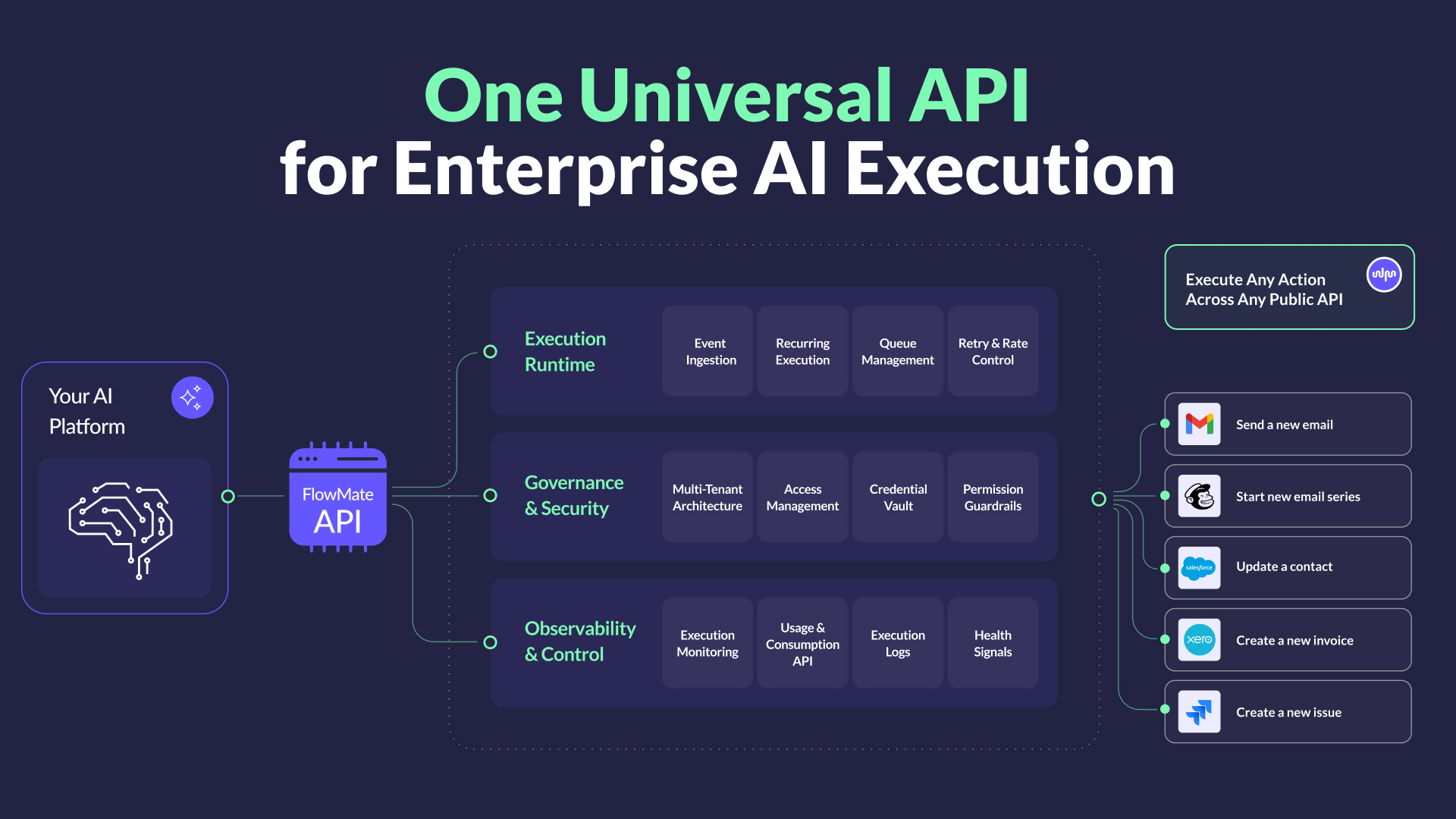
This allows AI teams to focus on intelligence and differentiation rather than operating distributed execution systems.

Unlock the Full Power of Your AI Platform
Enable secure, real-time third-party actions your AI can trigger instantly inside your product.
Power Your AI platform Now
From AI Interface to Operational Platform
There is a difference between an AI interface and an operational AI platform.
An interface generates output. A platform executes reliably.
The next generation of enterprise AI platforms will be defined not only by model quality, but by their ability to turn intent into governed, scalable, cross-app execution.
If you are building an enterprise AI platform and want to move from intelligent output to real-world action, let us discuss your use cases and explore how FlowMate can support your architecture.
Please book a personal meeting and let’s discuss your specific requirements.
Operationalize Your AI Platform
Enable controlled, real-time third-party actions your AI can trigger instantly across customer environments.

More articles from our Blog
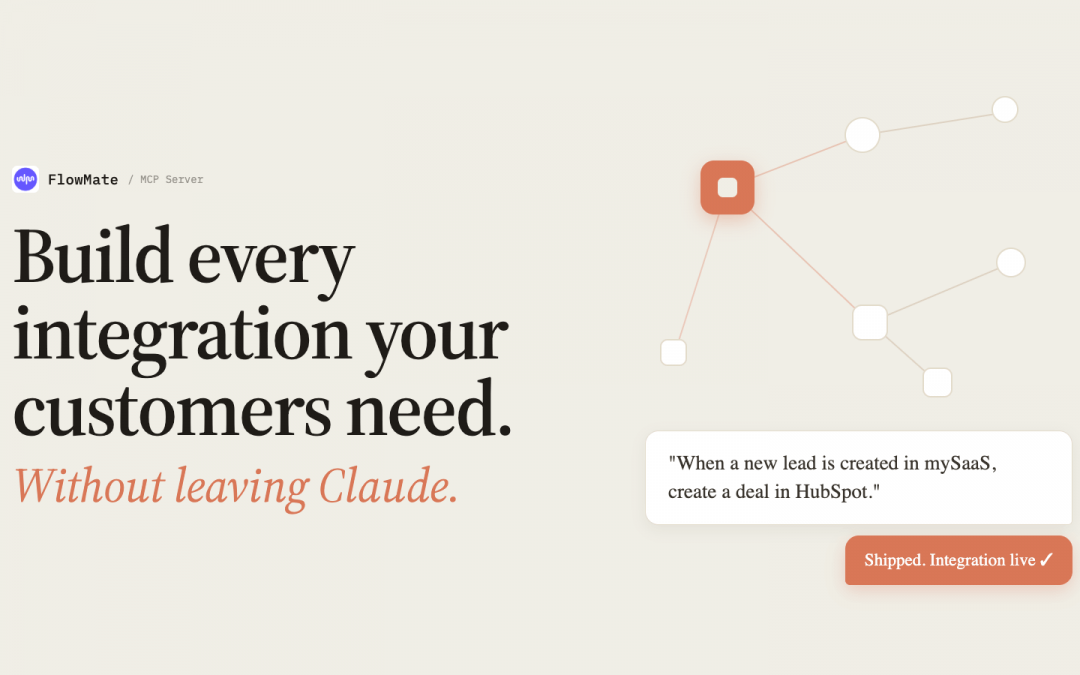
Build Every Integration Your Customers Need. Without Leaving Claude.
Building integrations is hard. Keeping them running is harder. This post shows how SaaS teams and AI platform builders can describe an integration in their own language and ship it the same day, monitor their entire automation operation through conversation, and fix production errors without leaving Claude.
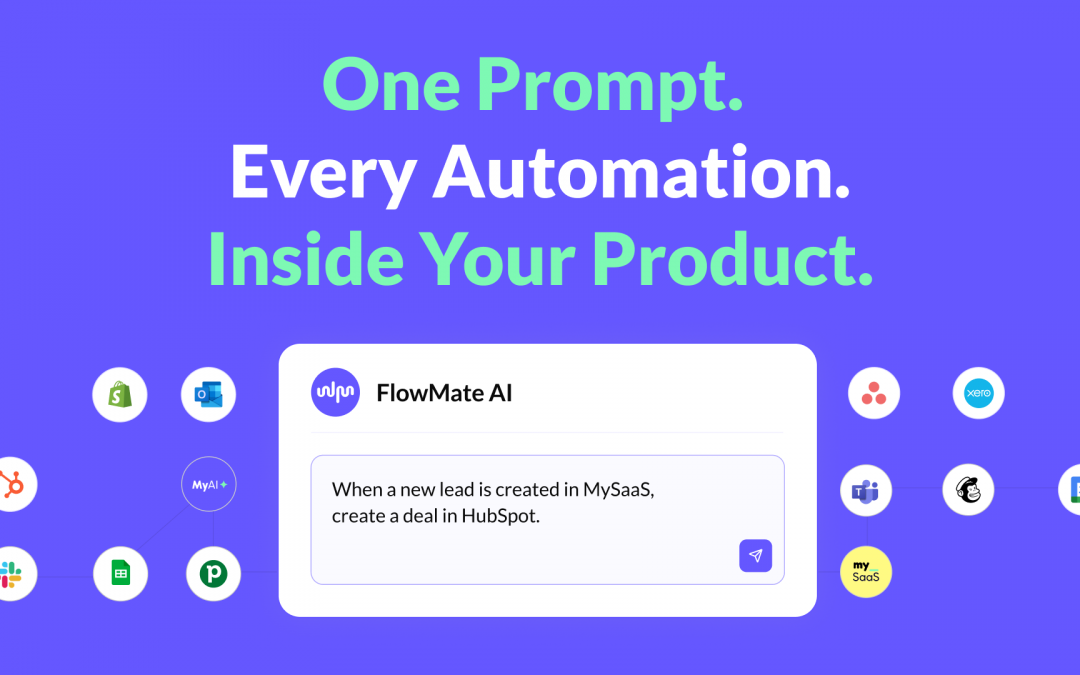
One Prompt. Every Automation. Inside Your Product.
Every customer is waiting for an integration you have not built yet. The reason is not a lack of ideas or ambition. Building integrations is harder than it looks. FlowMate AI gives any PM on your team the ability to turn a plain-language description into a production-ready cross-app integration and ship it the same day, without a developer, without a sprint, without the backlog.
The Automation Engine for AI and SaaS Platforms
For one or two customers, automation is a script. But once you are serving enterprise clients or a large customer base, it is infrastructure. This post explains how the FlowMate Automation Engine handles execution at platform scale, and why the gap between a working prototype and a production-ready multi-tenant system is larger than most teams expect.
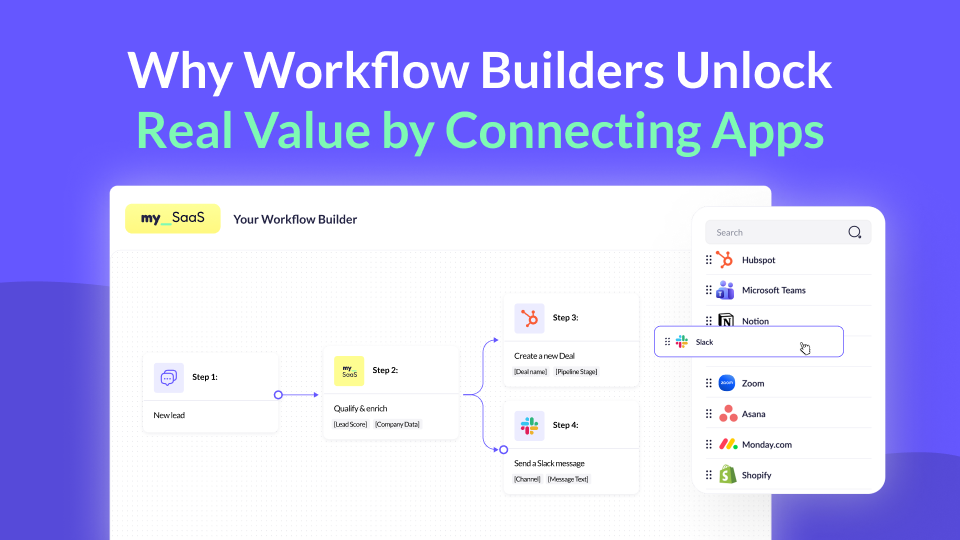
Why Workflow Builders Unlock Real Value by Connecting Apps
Workflow builders are becoming a key part of modern SaaS products. But where does their real value actually come from? In this post, we explore why connecting the apps customers already use makes workflow builders truly powerful, value-driving features, and why this matters more than ever.
Using MCP for Workflow Automation: What Works, What Doesn’t, and What You Actually Need
MCP standardizes how AI agents access tools, but it’s often mistaken for a workflow engine. In reality, it lacks structure, state, and governance. This article explains why MCP alone can’t power workflows and what additional layer you need to run automations reliably – including where FlowMate fits.
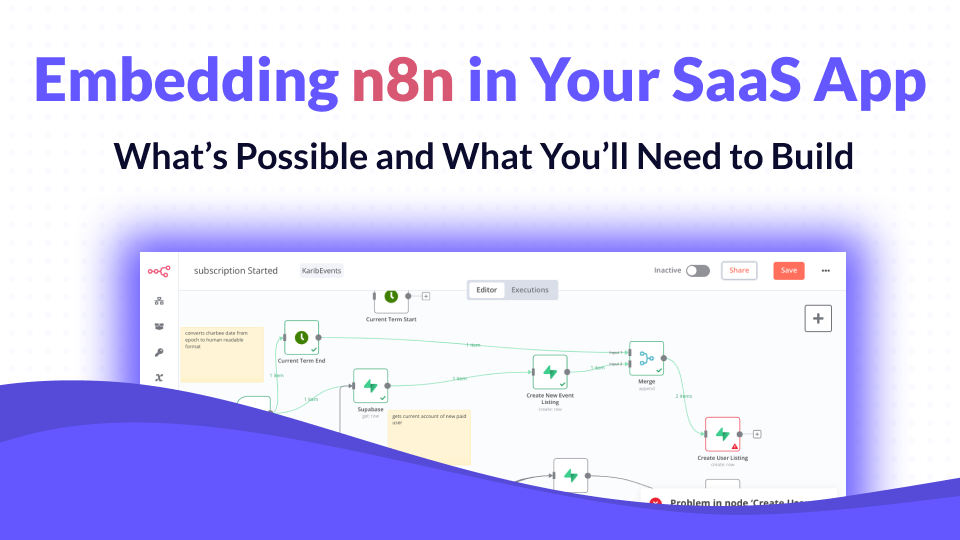
Embedding n8n in Your SaaS App: What’s Possible and What You’ll Need to Build
n8n has become one of the most popular workflow automation tools in the world, open-source, flexible, and developer-friendly. But when SaaS companies try to embed it into their own product, reality quickly gets complicated. In this article, we’ll unpack what n8n can do inside a SaaS product, what it can’t, and what you’d need to build to make it truly work at scale.
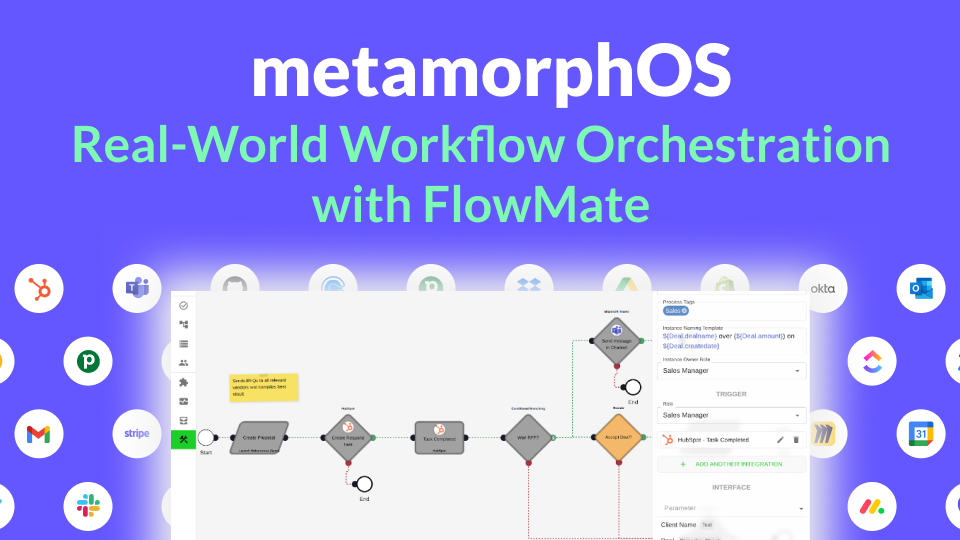
How metamorphOS Uses FlowMate to Power Real-World Workflow Orchestration
Discover how metamorphOS powers real-world workflow orchestration with FlowMate. By embedding FlowMate’s automation and integration engine, metamorphOS connects people, AI agents, and apps into seamless business processes. Learn how this partnership turns complex, manual workflows into scalable, automated success.
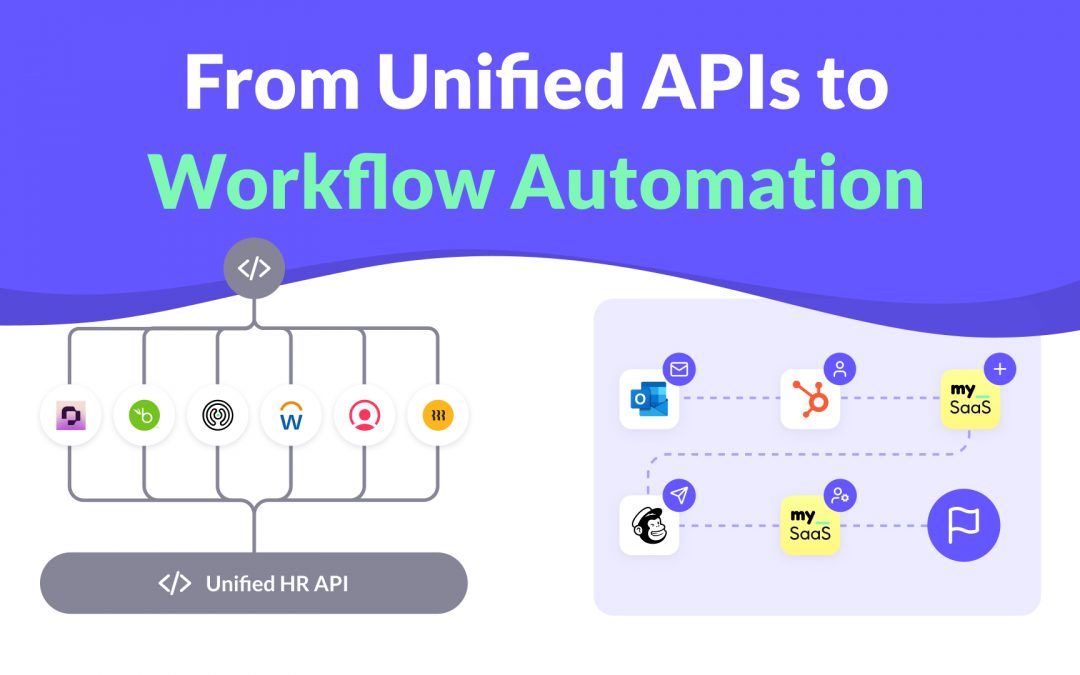
From Unified APIs to Workflow Automation
Unified APIs simplify data access, but modern SaaS products need more. This post explains why syncing data is not enough to deliver customer value and how event-driven triggers, actions, and workflows are redefining integration. Learn how moving from static connections to intelligent automation helps SaaS providers build integrations that adapt to real processes and create real workflow enablement.
How to Launch New Integrations: A Go-To-Market Playbook for SaaS Teams
Learn how to turn your next integration launch into a strategic growth campaign, not just a technical release. This step-by-step playbook shows SaaS teams how to unlock revenue, improve retention, and generate demand by treating integrations as powerful go-to-market assets, not just features. If you want more from your integration investments, this guide is for you.

Empower Your AI Agent to Execute Real Actions Across Any SaaS Tool
Many SaaS teams are racing to embed AI agents into their products, but most AI agents are starkly limited. Why? Because they lack the infrastructure to take real action across third-party tools. In this post, we unpack what’s missing, why the MCP standard matters, and how FlowMate MCP turns your AI agent into an operator by unlocking real automation across your customers’ stack.

Monetizing Automation & Integrations: Turn Customer Pain into Your MRR
Most SaaS companies underestimate the business value of automation and integrations. In this post, we explore how native automation not only improves product stickiness but also opens the door to entirely new revenue streams. Learn how to boost MRR while helping your customers save money by replacing costly third-party automation tools.

The Missing Piece in SaaS Workflow Automation: Real-Time Integrations
Many SaaS products offer workflow automation within their app—but real-time, event-driven integrations with third-party apps are often missing or hard to implement. In this post, we explore why they’re essential for modern SaaS platforms and how teams can overcome the technical hurdles.
Get all integrations you need always up to date
Access over 120 pre-built integrations for rapid connectivity with your SaaS. Get integrations from our roadmap tailored to your requirements in the short-term. We create any integration you need using public APIs by arrangement, ensuring your integration needs are met swiftly and effectively.
